

Chart 1: Expected maturities and redemptions
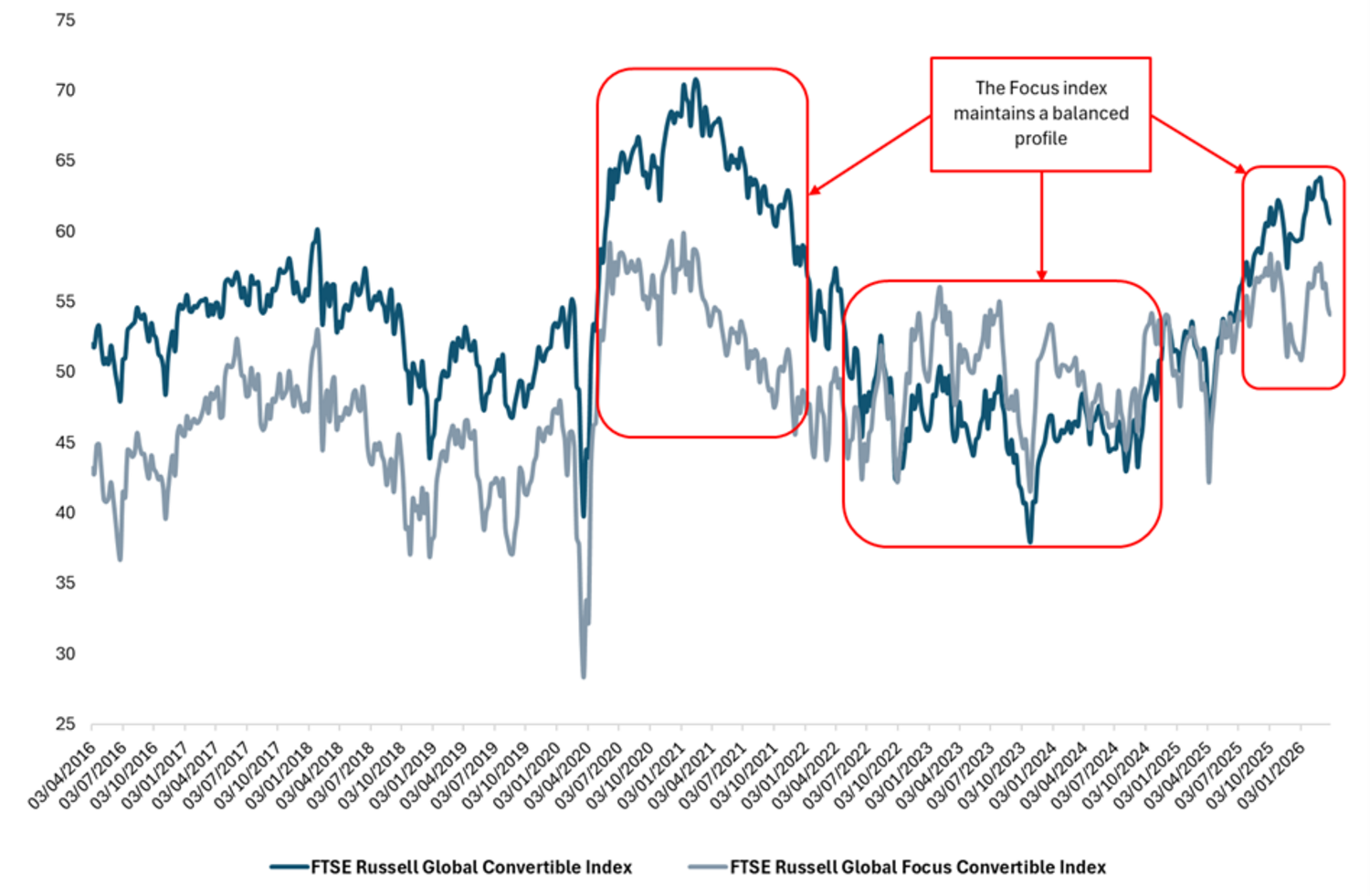
Convertible bonds delivered a standout 21.4%1 return last year, outstripping global equities (19.0%)2, global high yield (8.5%)3, and global aggregate (4.9%)4. The risk-adjusted returns were also noteworthy, with annualised volatility at 9.5% for convertibles, compared to 14.9% for global equities. This outperformance was driven by two structural shifts: improving market breadth and optimal upside capture.
The first of these was the broadening of the equity rally. Convertible bonds’ underlying equities outperformed global equities by 10.54%5 in 2025. The year was defined by improving market breadth, with more stocks participating in the global equities rally, while the reliance on the Magnificent 7 (Mag7) diminished. Notably, in Q1 2025, Mag7 EPS growth was 18.5% compared to 5.6% for the remaining 493 S&P 500 constituents6. In Q3, the numbers were 14.6% and 12.2%7, indicating more even participation across the index. With the median market capitalisation for convertible bonds’ underlying equities being c.USD8bn, it was no surprise to see convertibles performing strongly in that context.
Second, convertibles captured 72.4% of their underlying equities’ strong performance – up 21.4% against 29.6%8. Multiple factors supported this. Some USD343bn of new issuance since 2023, which is 69% of the total market9, ensured a renewal of the asset class’s structure and opportunity pool in a context of stubbornly higher-for-longer rates.
This resulted in improved terms for investors: higher coupons and lower conversion premiums, meaning both stronger downside protection and increased upside participation. A year marked by immense volatility, dispersion, and sector rotations creates the perfect backdrop for convertibles to exhibit their convexity characteristics, as the April tariff-induced sell-off demonstrated.
2026 is shaping up to be no different.
This year’s equity market landscape is showing further improvements for convertible bonds. Year to date, global SMID stocks have outperformed large caps by more than 570bps and the MSCI World Equal-Weight has outperformed the MSCI World by 430bps10.
In other words, the rally has broadened significantly, with 58% of the constituents of the MSCI World outperforming the index. Looking specifically at convertibles’ underlying equities, dispersion is on the rise while the average underlying volatility is in its 95th percentile relative to the last five years11.
Simply put, the conditions for convertibles to express their diversification benefits are at least the same – if not even better – than in 2025.
We expect issuance volumes and terms for 2026 to at least match last year’s, since some USD180bn of convertibles are set to be refinanced across 2026 and 2027 (see chart 1). When rates were zero or negative a decade ago, one could argue about companies tapping convertibles opportunistically − typically when their share price was high – but today’s set-up is completely different.
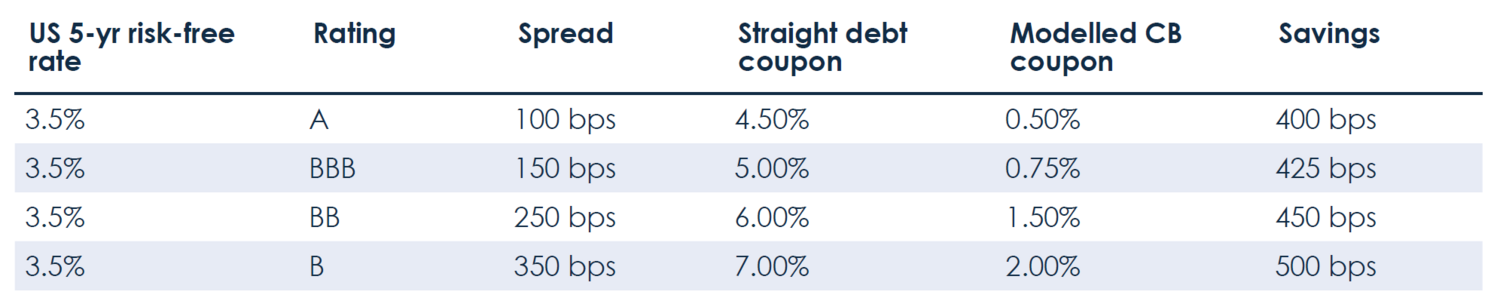
With rates higher for longer, substantial coupon savings are luring both SMID and large-cap companies into the asset class even if it means risking diluting their capital base (see table 1).
Table 1: Coupon savings via convertible issuance remain compelling
Ultimately, convertibles no longer have to prove why they are an integral part of an asset allocation. They are an excellent diversifier to both fixed income (60% of convertible issuers do not have any other form of public debt) and equities (median market capitalisation USD8bn).
They are also incredibly useful for navigating volatility and dispersion, as the absolute, relative, and risk-adjusted performances of the last 18 months have proven. Crucially, the macro and micro conditions that underpin the asset class – from high rates and volatility to improving breadth and issuance – are here to stay. Convertibles have firmly moved from the periphery to the core.
1 FTSE Refinitiv Global Convertible Index (USD Hedged) 2 MSCI World USD Hedged 3 ICE BofA Global HY USD Hedged 4 Bloomberg Global Aggregate USD Hedged 5 Bloomberg, Mirabaud Asset Management, 31 December 2025 6 LSEG I/B/E/S | 7 LSEG I/B/E/S 8 Bloomberg, Mirabaud Asset Management, full-year 2025 9 BofA, Mirabaud Asset Management 10 MSCI, 13 February 2026 11 BofA, 18 February 2026 |
IMPORTANT INFORMATION
This publication is for information, education, and non-commercial purposes only. It is not suitable for readers who have no prior knowledge of financial markets. The views and opinions expressed are those of the named author(s) and may not necessarily represent views expressed or reflected in other Mirabaud communications.
It does not constitute an offer and is not intended to provide investment advice or investment recommendations. Any sectors, asset classes, securities, regions or countries shown are for illustrative purposes only and are not to be considered a recommendation to buy or sell. This publication is not intended for and cannot be shared with any person who is a citizen or resident of any jurisdiction where the publication, distribution or use of the information contained herein would be subject to any restrictions.
Past performance does not predict future returns. All investment involves risks, including loss of the money invested. Diversification does not necessarily ensure a profit or protect against losses in declining markets. There is no guarantee that any particular asset allocation or mix of investments will meet given investment objectives or generate a given level of income. Exchange rate changes may cause the value of any cross-border investments to rise or fall. In general, investments in stocks and bonds are subject to risks such as country/regional risk, issuer, volatility and currency risk, which are not necessarily addressed herein. Do not base any investment decision on this publication alone.
This publication has been prepared without taking into consideration the objectives, financial situation or needs of any particular investor or type of investor. Neither the issuer nor its affiliates accept liability for any loss incurred in connection with the use of the information available in this publication. The sources used are deemed reliable. However, the accuracy or completeness of the information cannot be guaranteed, and some figures may only be estimates. Statements of facts, opinions, estimates, analysis or conclusions contained herein are provided in good faith and without obligation to update, revise or complete. They are subject to change without notice and may be revised at any time. This material may include projections, forecasts, and other forward-looking statements which are hypothetical in nature. They involve certain risks and uncertainties that could cause actual results to differ from those stated herein.
Mirabaud Asset Management (MAM), all rights reserved. Partial reproduction subject to proper quoting, full reproduction subject to MAM prior consent.


Continue to
