

Market performance in 2025 shone a light on a key feature of the convertible bond space that is often misunderstood: indices.
Due to their hybrid nature, convertibles can exhibit different behaviours – bond-like, balanced or equity-like – meaning broad indices can mask very different underlying dynamics. When large issuers see their share prices rise meaningfully, their convertibles can become increasingly equity-like, lifting overall index performance. However, these more equity-like convertibles are typically not the segment of the market where long only managers are most active, as they tend to focus on the convex part of the universe.
That’s the reason why there are two main families of indices. On one hand, “broad” indices track the performance of the wider convertibles universe (e.g. FTSE Russell Global Convertible, Global Vanilla and Global Qualified indices). On the other hand, “focus” indices (e.g. Global Focus, Global All-Cap Focus) track the performance of the “balanced” subset.
Over the long term, particularly in the context of a secular bull market marked by strong momentum, the performance differential between the two index types is clear. The FTSE Russell Global Convertible Index in the “broad” category, which tracks all reasonably liquid convertibles, including those deep in or out of the money, is up 139% over the last 10 years1. By contrast, in the “focus” category, the FTSE Russell Global Focus Convertible Index, which tracks the balanced universe, is up 66%1. The trend in 2026 is no different year to date, with an outperformance of more than 360bps2 by the “broad” index, driven exclusively by deep in-the-money convertibles, including Lumentum, Western Digital and SK Hynix.
Digging deeper, we can note a couple of observations: the “broad” index family is typically 30% more volatile than “focus”, while their deltas vary more significantly. Unlike broad indices, the FTSE Russell Global Focus Convertible Index rebalances monthly to ensure continued convexity by excluding convertibles that have become bond-like or equity-like and adding both balanced new issues and newly balanced bonds.
Chart 1: Delta divergence between “broad” and “focus” convertible indices
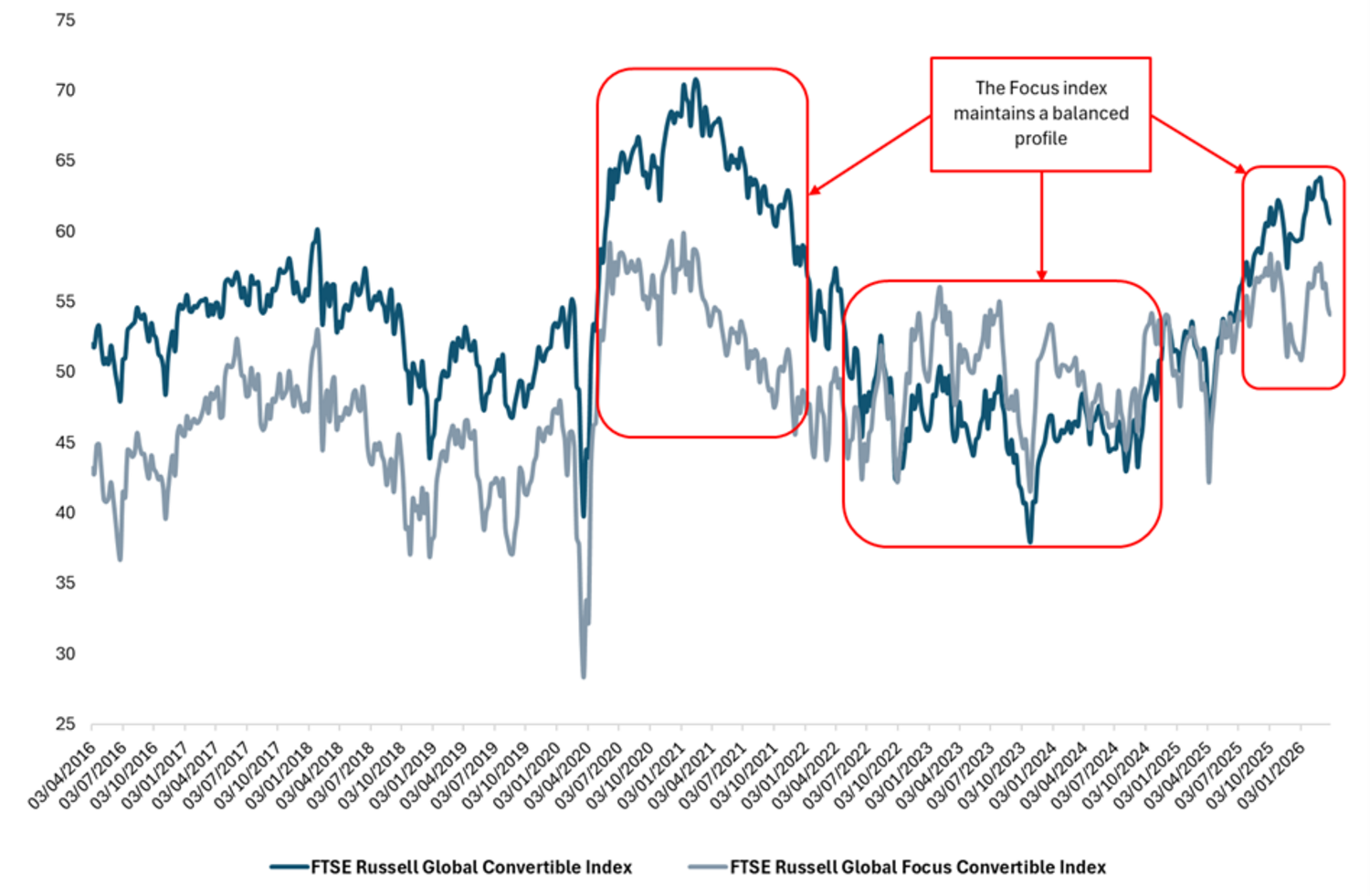
As a result, after a large drawdown – when the overall equity sensitivity of the space is on the lower end, such as in 2022 – the delta of the “focus” index remains in balanced territory, unlike the “broad” index. Conversely, during bull markets, such as 2025–2026, “focus” indices are the only ones maintaining a balanced profile composition.
Therefore, when assessing the convexity of a given index, one needs to consider its composition in terms of convertible bond profiles. While both theoretical portfolios detailed in Table 1 exhibit a 50% delta, they will not behave the same way in the case of upside/ downside shocks, as the position with a 100% delta is likely to be very far away from the downside protection of its bond floor.
Transposing this view to the current index landscape, the main takeaways are clear. More than a third of the global “broad” index has a delta above 80%, compared with 9% for the global “focus” index. At the higher end, almost a quarter of the “broad” index has a delta above 90%, versus just 3% for the “focus” index (see Chart 2).
Put simply, convertibles with such profiles are so far removed from their bond floors that they exhibit virtually zero downside protection during most drawdowns.
Table 1: Identical delta, different convexity profiles

Chart 2: “Broad” vs. “focus” indices: distribution across delta ranges
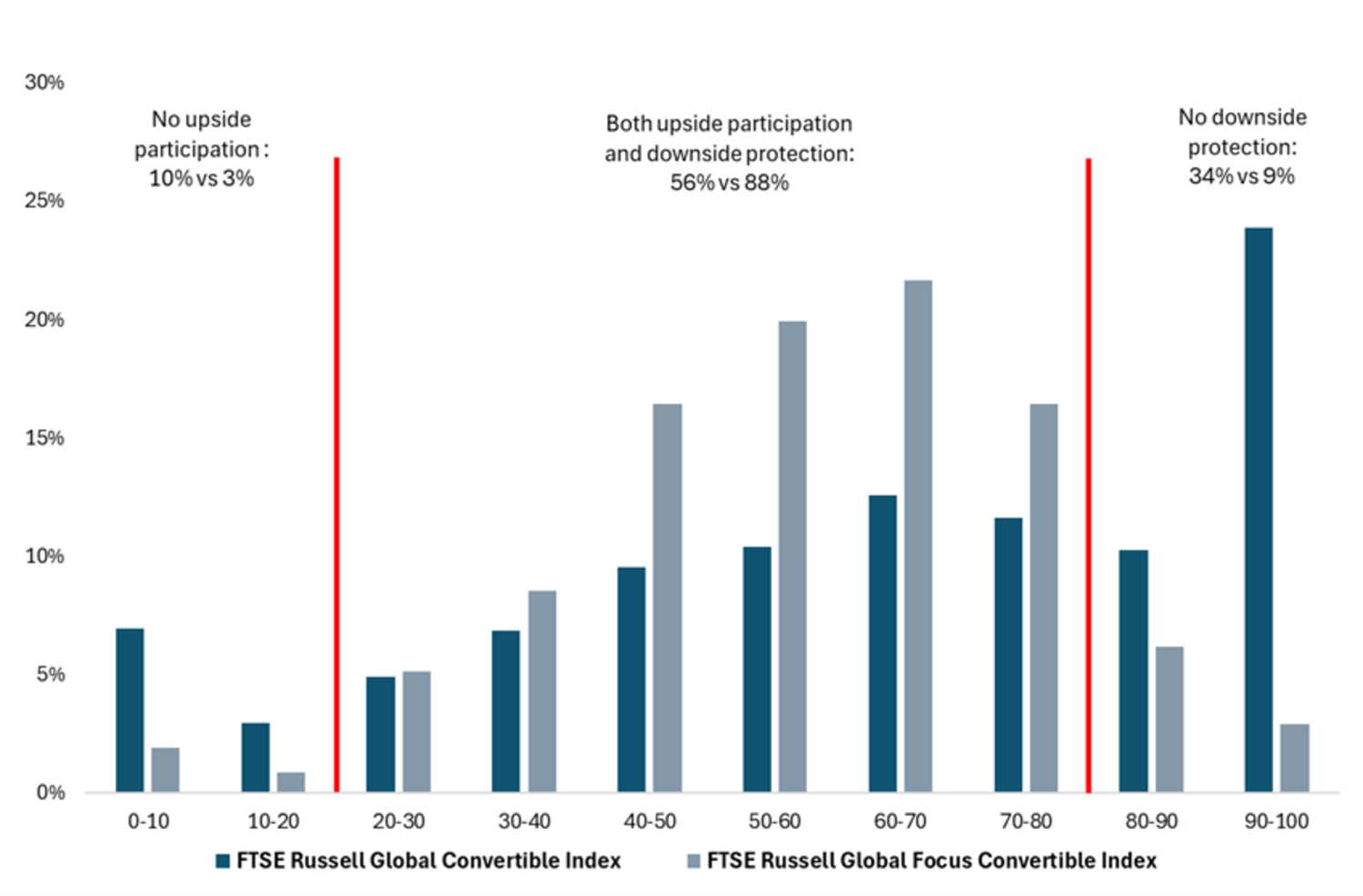
So, while the deltas of the global “broad” and “focus” indices might be similar, their expected outcomes in case of a drawdown are unlikely to be. And this is arguably what matters most in the current environment. The portion of the global “broad” index invested in convertibles with a delta above 80% is far from a level where delta would decrease meaningfully as share prices fall.
Specifically, looking at the 10 largest weights in the global “broad” index, most of them are not in a position to provide protection in a bear market, as illustrated in Table 2.
Table 2: Top 10 weights in the global “broad” convertible index: delta and downside profile
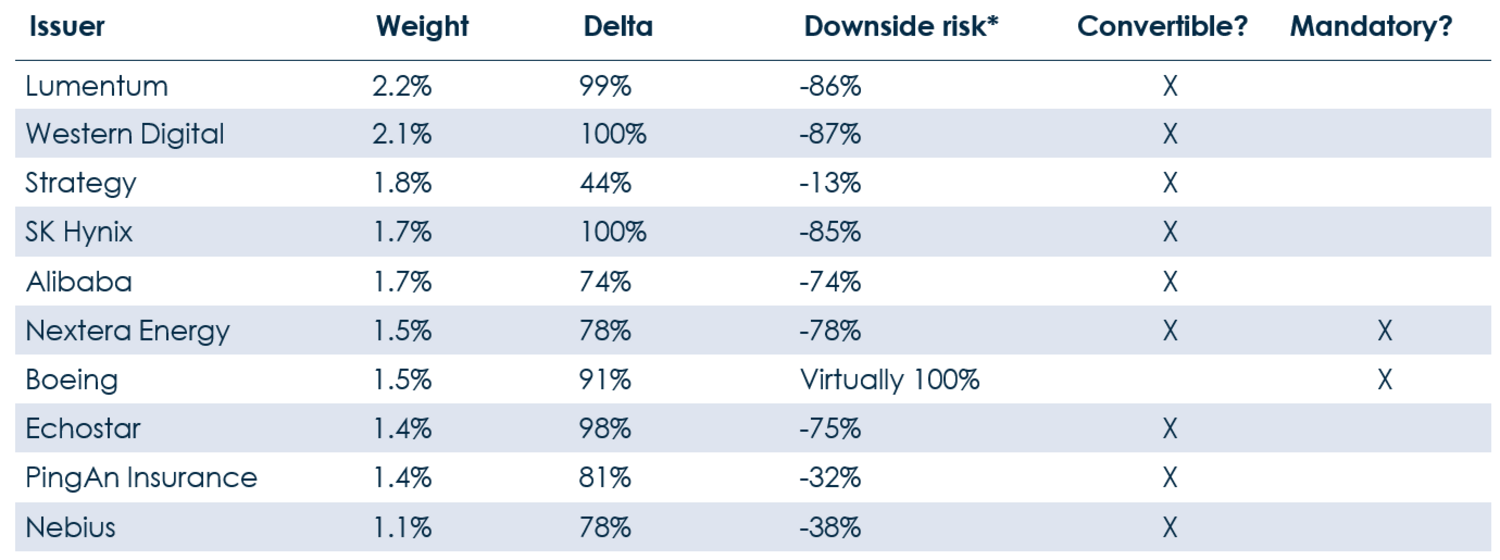
Be it due to their profiles (for example, all Lumentum bonds trade above 500, while Hynix and Western Digital trade above 800) or their features (Nextera and Boeing both have multiple mandatories, which by definition offer no bond floor), most of these bonds would need to see an extremely severe equity drawdown to exhibit a convex behaviour and cushion the downside – likely in the order of at least 60 –70%. At the same time, bonds with a delta below 20% are unlikely to provide sufficient carry or protection either, as spreads would typically
widen.
In a nutshell, when investing, it is important to be aware of the profiles of convertibles. In today’s environment, following the “broad” convertibles market means being significantly exposed to the tails of the universe − both equity profiles and bond profiles − which notably hinders the role convertibles are intended to play in a multi-asset portfolio. Conversely, by following the balanced subset through the “focus” indices, investors can maintain convexity through a whole market cycle.
Put another way, the hybrid nature of the convertible product is why we believe an active approach makes more sense than a buy-and-hold strategy, as illustrated by the difference in turnover between the two indices (global “focus” index turnover of 150% in 2025 versus 63% for the global “broad” index). As always, the devil is in the details.
1 FTSE Russell as at 31 March 2026
2 FTSE Russell as at 31 March 2026
All references to global “broad” index refer to the FTSE Russell Global Convertible Index and all references to the global “focus” index refer to the FTSE Russell Global Focus Convertible Index unless otherwise stated.
IMPORTANT INFORMATION
The content on this page is intended for professional investors only and should not be relied upon by retail or private investors.
This publication is for information, education, and non-commercial purposes only. It is not suitable for readers who have no prior knowledge of financial markets. The views and opinions expressed are those of the named author(s) and may not necessarily represent views expressed or reflected in other Mirabaud communications.
It does not constitute an offer and is not intended to provide investment advice or investment recommendations. Any sectors, asset classes, securities, regions or countries shown are for illustrative purposes only and are not to be considered a recommendation to buy or sell. This publication is not intended for and cannot be shared with any person who is a citizen or resident of any jurisdiction where the publication, distribution or use of the information contained herein would be subject to any restrictions.
Past performance does not predict future returns. All investment involves risks, including loss of the money invested. Diversification does not necessarily ensure a profit or protect against losses in declining markets. There is no guarantee that any particular asset allocation or mix of investments will meet given investment objectives or generate a given level of income. Exchange rate changes may cause the value of any cross-border investments to rise or fall. In general, investments in stocks and bonds are subject to risks such as country/regional risk, issuer, volatility and currency risk, which are not necessarily addressed herein. Do not base any investment decision on this publication alone.
This publication has been prepared without taking into consideration the objectives, financial situation or needs of any particular investor or type of investor. Neither the issuer nor its affiliates accept liability for any loss incurred in connection with the use of the information available in this publication. The sources used are deemed reliable. However, the accuracy or completeness of the information cannot be guaranteed, and some figures may only be estimates. Statements of facts, opinions, estimates, analysis or conclusions contained herein are provided in good faith and without obligation to update, revise or complete. They are subject to change without notice and may be revised at any time. This material may include projections, forecasts, and other forward-looking statements which are hypothetical in nature. They involve certain risks and uncertainties that could cause actual results to differ from those stated herein.
Mirabaud Asset Management (MAM), all rights reserved. Partial reproduction subject to proper quoting, full reproduction subject to MAM prior consent.


Continuer vers
