Source: Ørsted Investor Presentation, Q1 2021
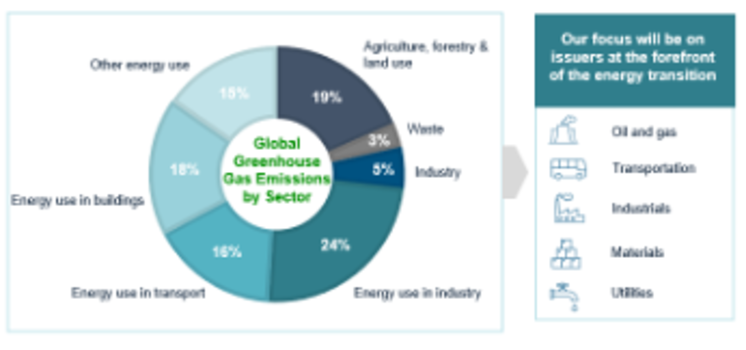
More recently, in May 2020, Total adopted a new climate ambition to get to net zero by 2050. These examples highlight the importance of the oil and gas sectors in the energy transition.
Despite the pandemic, oil demand is expected to return to 2019 levels by late 2021 or early 2022[7] as economies grow. In 2019, the International Energy Agency announced that ‘the world’s thirst for oil will continue to grow until the 2030s and climate-damaging emissions will keep climbing until at least 2040.[8]
We believe this makes engagement with oil and gas companies an important part of a climate strategy, incentivising the move to low-carbon technologies, including renewables, bioenergy and carbon capture to reduce greenhouse gas emissions. This will be one part of our engagement strategy.
Momentum of change
Our focus is to assess the momentum of change in how issuers are successfully reducing their emissions.
We have a structured framework in place for engagement and collecting metrics. We are looking at three key areas – issuer companies with high (direct and indirect) greenhouse gas emissions; issuer companies in sectors that have a major role to play in the transition to a net-zero emissions economy; and, finally, companies not aligned with 2 degrees C. We then allocate our time based on priority sectors.
The top priority sectors are more energy intensive and include Utilities, Energy, Basic Materials, Industrials, Transportation and Energy Intensive Consumer Goods. Second tier sectors include technology, financials, communication and healthcare.
We’ll leverage leading data providers and standards (Trucost, Science-based targets initiative and Transition Pathway initiative) to track company emissions over the medium term and assign individual companies a ‘’temperature’’ summarising its climate alignment so our approach is in line with science-based international best practice.
In summary, through our energy transition approach, our Climate Bond Strategy has the flexibility to invest in any issuer, from any sector, focusing on those issuers that are thinking about reducing their emissions, using cleaner and more efficient power sources.
[1]www.europarl.europa.eu/meetdocs/2014_2019/plmrep/COMMITTEES/ENVI/DV/2020/12-10/EGR2020_ENVI_10DecEN.pdf
[5]https://www.weforum.org/agenda/2020/11/cost-renewable-energy-falling-race-to-zero-emissions/
[7]www.mckinsey.com/industries/oil-and-gas/our-insights/global-oil-supply-and-demand-outlook-to-2040
Important Information
This marketing document contains information or may incorporate by reference data concerning certain collective investment schemes ("funds") which are only available for distribution in the countries where they have been registered. This document is for the exclusive use of the individual to whom it has been given and may not be either copied or transferred to third parties. In addition, this document is not intended for any person who is a citizen or resident of any jurisdiction where the publication, distribution or use of the information contained herein would be subject to any restrictions or limitations.
The contents of this document are provided for information purposes only and shall not be construed as an offer or a recommendation to subscribe for, retain or dispose of fund units, shares, investment products or strategies. Before investing in any fund or pursuing any strategy mentioned in this document, potential investors should consult the latest versions of the relevant legal documents such as, in relation to the funds, the Prospectus and, where applicable, the Key Investor Information Document (KIID) which describe in greater detail the specific risks. Moreover, potential investors are recommended to seek professional financial, legal and tax advice prior to making an investment decision.
The sources of the information contained in this document are deemed reliable. However, the accuracy or completeness of the information cannot be guaranteed, and some figures may only be estimates. There is no guarantee that objectives and targets will be met by the portfolio manager.
All investment involves risks. Past performance is not indicative or a guarantee of future returns. Fund values can fall as well as rise, and investors may lose the amount of their original investment. Returns may decrease or increase as a result of currency fluctuations.
This communication may only be circulated to Eligible Counterparties and Professional Investors and should not be circulated to Retail Investors for whom it is not suitable
This document is issued by the following entities: in the UK: Mirabaud Asset Management Limited which is authorised and regulated by the Financial Conduct Authority under firm reference number 122140.; in Switzerland: Mirabaud Asset Management (Suisse) SA, 29, boulevard Georges-Favon, 1204 Geneva, as Swiss representative. Swiss paying agent: Mirabaud & Cie SA, 29, boulevard Georges-Favon, 1204 Geneva. In France: Mirabaud Asset Management (France) SAS., 13, avenue Hoche, 75008 Paris. In Spain: Mirabaud Asset Management (España) S.G.I.I.C., S.A.U., Calle Fortuny, 6 - 2ª Planta, 28010 Madrid. The Prospectus, the Articles of Association, the Key Investor Information Document (KIID) as well as the annual and semi-annual reports (as the case may be), of the funds may be obtained free of charge from the above-mentioned entities.