What have been your major priorities during the Covid-19 crisis?
We felt the UK was in good shape at the beginning of the year, post the election result in December. Following a lot of uncertainty, especially with Brexit and domestic political woes, we were anticipating a return to normality. Then the world changed overnight with the advent of Covid-19, which resulted in a major change in outlook, significant businesses stresses and a highly disorderly market.
Our first priority was to understand the nature of the stresses that businesses would face: a near-universal catastrophic drop in revenue is not a conventional stress-test. Our priorities were to find businesses with resilient revenues, flexible costs (such that monthly cash-burn would not be too great) and resilient balance sheets (the challenge being that even the strongest balance sheet could not withstand a prolonged period of zero revenue whilst incurring high running costs).
Next, we needed to understand the factors behind the market sell-off, because despite the Covid-19 challenges, the share price responses we were seeing were not consistent with the analysis above. We suspect that the main drivers of this disorderly market included forced deleveraging from certain hedge funds. The first response of most corporates was to draw upon any liquidity lines with their banks; this materially reduced any excess liquidity and required banks, particularly those lending USD in Europe, to withdraw funding from low-risk but asset-intensive levered carry trades. This resulted in hedge funds being forced to shrink and seek some form of offsetting hedge to protect performance. There also appears to have been some conventional panic selling of whatever performed poorly during 2008, without thinking too hard about whether businesses had changed in the interim.
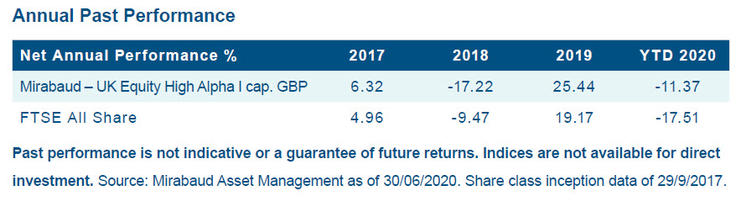
Against this backdrop some extraordinary opportunities began to appear. We were able to build large positions in high conviction holdings at valuations which completely de-risked the investment over any sensible time-frame. Actively navigating this market resulted in the Mirabaud – UK Equity High Alpha Fund outperforming the FTSE All Share Index by 11.45% since the beginning of the second quarter and left the Fund ahead of the FTSE All Share Index by around 4.6% for the year to date (17 July)*.
Valuing companies during a disorderly market
As we entered the crisis in Spring, one of the assumptions we made is that very few businesses would be making much profit in 2020. We then considered the impact this would have on the valuation of a company. In crude terms, the loss of a year or two of cashflow over a long term Discounted Cash Flow causes around a 10% reduction in net present value. However, the scale of the drop we saw in long-term risk-free rates would have offset all of this. In other words, despite the short-term impact, the net present value of equities was probably unchanged… with a caveat: if the business failed during this period, the loss of value would be significant.
Our role as active, high conviction managers is to identify businesses that are resilient. If you have high conviction that the businesses you are investing into are not going to fail, their share prices should not have been down anywhere near the amount that many were. This gave us the confidence to increase existing holdings, while everyone else was de-risking and selling. This is where active stockpicking comes into its own.
Applying our conviction
We believe that active management was critical during this period and that a combination of high conviction stock picking and a focus on low risk helped to push the UK High Alpha Fund ahead year to date. We took larger positions in companies that we believe are highly resilient, including Hargreaves Landsdown, Taylor Wimpey, St James’s Place, Fever-Tree and Intermediate Capital Group – increasing weightings between 20%-160%. It is important to note that the performance was not simply the result of a rebound in prices; the key drivers of performance on the way up were different from those on the way down and the result of active investment decisions.
Some of the biggest increases we made were in Intermediate Capital, a specialist private debt and equity fund manager, and Fever-Tree, the high-end tonic water brand. Intermediate Capital has changed completely over the last 10 years and, as a result of 7-10 year locked-in investment vehicles which charge fees on capital deployed (not marked-to-market valuations), has probably the most resilient revenue stream of any business in the UK. Meanwhile, we felt that Fever-Tree was being sold far too aggressively, as this came on top of an already excessive reaction earlier in the year. The market had previously reacted very negatively to a change in price architecture for their products in the USA; we had believed this already to be a significant misunderstanding of the business and this additional sell-off gave us a great opportunity to build holdings in a fabulous business. We felt similarly about Hargreaves Landsdown, the funds and share platform.
We funded these increases by exiting some of the period’s outperformers, including Reckitt Benkiser, Ferguson and YouGov.
ESG Scores Highly
Environmental, Social & Governance issues are high on our agenda and we worked closely with the ESG team to identify any risks in our new holdings. A good working example of this is Fever-Tree, which makes premium tonic water. As we worked alongside our ESG team, we found that the company had some issues around poor disclosure, rather than working practices, which impacted their ESG scores. We subsequently engaged with management on their disclosure policies, leading to a positive outcome as they recognised the need for improvements.
As we engaged with the management of Fever-Tree, we also raised other topics, including climate change risk. The company sources most of its quinine from the Democratic Republic of Congo (DRC), a region that can be unstable, which means it is important for the company to safeguard its supply chains. However, changes in climate can impact the longer-term viability of crops, especially in equatorial Africa, where General Circulation climate models struggle to predict outcomes. While we cannot forecast what climate change will do, we can engage with the company management team to ensure their on-the-ground practices are as resilient and forward looking as they can be.
Finally, it’s worth noting that our ESG ‘scores’ are currently ahead of the benchmark**. However, we can still be held back by younger businesses, where sustainable practices are good but whose disclosures are poor, leading to weaker ESG ‘scores’. As a result, over the next twelve to twenty-four months we will be engaging with all the companies in our portfolio to remedy this.
Reasons to be cheerful
Despite fears of prolonged economic disruption, we think that things are more benign than many had expected. Indeed, the UK is gradually recovering and is coming out of furlough more rapidly than anticipated. Against this backdrop, higher earners have generally continued to work. This has resulted in high levels of savings and pent-up demand that we believe should be supportive to the economy as it begins to open up again and help get furloughed workers back to work.
The UK has been an unpopular place to invest since the middle of 2016 and, as a result, the market is now structurally undervalued relative to other developed markets. In fact, we believe that mispricing is rife across all parts of the UK market, from technology, consumer stocks and housebuilders.
Finally, the conventional wisdom in the markets currently is that Europe is more strongly placed economically than the UK. However, this sentiment may be misplaced. Southern Europe, for example, is very seasonal and may be severely impacted by the downturn in the tourist industry. Greece could experience severe disruption if tourists don’t turn up in sufficient numbers – their summer months contribute to a large percentage of their annual GDP. In the UK, however, the economy is less seasonal, with each quarter contributing more or less the same towards the annual GDP number: economic risks over the summer are not evenly distributed.
We are therefore optimistic about the UK more broadly, the valuations on offer in the UK stock market and our portfolio in particular.
Brexit’s Back
Brexit talks are also back on the agenda. However, it’s important to look at what is being traded. The principal UK imports are discretionary – cars and holidays – while the largest UK exports are financial services and medicine. UK consumers can delay the purchase of a new car or an overseas holiday without too much impact, whereas European consumers would be far more affected by impaired access to medicines and financial services.
In terms of the negotiations, logic suggests that a compromise of some form will be reached. The advantage that UK investors have is that these issues are well-flagged and much worried about. Consequently, there should be significant upside if we have a benign outcome and less downside if we do not. The other advantage is that valuations of just about all businesses have been dragged down over the last few years relative to their international peers, regardless of their exposure to the UK economy. Nevertheless, there remains a risk that a ‘no-deal’ event triggers an outbreak of market panic, much like we saw this March, and another great opportunity for high conviction stock pickers.